Beginner's Guide to Pilates: What to Expect in Your First Session
Thinking about trying Pilates but not sure what to expect? You’re not alone. Every week, I meet new clients at USA Pilates who are curious about Pilates but intimidated by the unfamiliar equipment, concerned they’re not flexible enough, or worried they won’t be able to keep up.
Let me put your mind at ease: Pilates is for every body. Whether you’re a competitive athlete, someone recovering from an injury, a busy parent looking to rebuild core strength, or simply wanting to feel better in your body—Pilates meets you exactly where you are.
After 18 years of teaching Pilates and introducing hundreds of beginners to this transformative practice, I’ve learned that the biggest barrier to starting is simply not knowing what to expect. So let’s demystify Pilates and walk through exactly what happens in your first session.
What is Pilates, Really?
Before we talk about your first session, let’s clarify what Pilates actually is—because there’s a lot of confusion out there.
Pilates is a method of exercise developed by Joseph Pilates in the early 20th century that focuses on controlled movements, core strength, flexibility, and mind-body connection. It’s not yoga (though they share some principles), it’s not just stretching (though flexibility improves), and it’s definitely not easy (though it’s accessible to all fitness levels).
The core principles of Pilates:
- Concentration: Every movement requires focused attention
- Control: Movements are precise and deliberate, never rushed or sloppy
- Center: All movement originates from a strong core
- Breath: Specific breathing patterns coordinate with each exercise
- Precision: Quality matters more than quantity
- Flow: Exercises transition smoothly, creating graceful movement
Think of Pilates as strength training for your entire body, with special emphasis on the deep core muscles that stabilize your spine and pelvis. Unlike lifting weights at the gym where you might do 10 reps and rest, Pilates keeps your muscles working continuously, building strength and endurance simultaneously.
Mat Pilates vs. Equipment Pilates: What's the Difference?
This is one of the most common questions I hear from beginners, and it’s important to understand the distinction:
Mat Pilates uses primarily your body weight, performed on a mat on the floor. You might use small props like resistance bands, balls, or magic circles, but the main resistance is your own body. Mat classes can accommodate larger groups and are what you’ll typically find at gyms or fitness studios.
Equipment Pilates (also called Reformer Pilates or Classical Pilates) uses specialized apparatus designed by Joseph Pilates himself:
- Reformer: A sliding carriage with springs that provide resistance
- Cadillac/Tower: A frame with bars and springs for various exercises
- Chair: A low box with springs and pedals
- Step Barrel: A curved barrel for stretching and strengthening
- Ladder Barrel: A barrel with a ladder for advanced work
Which is better for beginners? Neither—they’re different, and both have unique benefits. However, equipment Pilates often provides more assistance and feedback for beginners. The springs help support your movements, making some exercises easier to learn and perform correctly.
At USA Pilates, we primarily use equipment-based Pilates because it allows for incredible customization—I can adjust springs to make exercises easier or harder, provide assistance where you need it, and create progressions that match your exact fitness level.
Before Your First Session: How to Prepare
The good news? You need very little to prepare for your first Pilates session.
What to Wear
- Fitted, comfortable athletic wear: Think yoga pants or leggings and a fitted tank top or t-shirt. Avoid baggy clothes—I need to see your body alignment, and loose clothing can get caught in equipment.
- No jeans, denim, or clothing with zippers: These can damage equipment and restrict movement.
- No shoes: Pilates is done barefoot or in grippy socks. This allows your feet to strengthen naturally and prevents equipment damage.
- Avoid dangly jewelry: Necklaces, bracelets, and large earrings can get in the way or catch on equipment.
What to Bring
- Water bottle: Pilates is more challenging than it looks. You’ll be thirsty.
- Hair tie: If you have long hair, tie it back so it doesn’t obstruct your vision or get caught.
- Any relevant medical information: More on this below.
- An open mind: That’s truly all you need.
What to Eat (or Not Eat) Come to your session hydrated but not on a completely full or empty stomach. A light snack 1-2 hours before is perfect. Avoid heavy meals immediately before—you’ll be doing exercises that involve bending, twisting, and lying on your stomach, which isn’t pleasant with a full belly.
Mental Preparation Here’s what you don’t need to worry about:
- Being flexible (Pilates will improve your flexibility)
- Being strong (Pilates will build your strength)
- Knowing any exercises (I’ll teach you everything)
- Keeping up with anyone else (in private sessions, you’re the only client)
- Looking foolish (everyone starts somewhere, and I’ve seen it all)
What Happens During Your First Session
Let me walk you through exactly what occurs in a typical first session at USA Pilates:
Part 1: Intake and Assessment (10 minutes
We’ll start by talking. I’ll ask you questions about:
Your Goals
- Why did you decide to try Pilates?
- What do you hope to achieve?
- Are you training for anything specific?
- What does success look like for you?
Your Medical History
- Any current or past injuries?
- Chronic pain or physical limitations?
- Surgeries or medical conditions I should know about?
- Are you currently pregnant or postpartum?
Your Activity Level
- What sports or activities do you currently do?
- What’s your exercise background?
- Any activities that cause pain or discomfort?
This information is crucial. It allows me to customize your session completely. The exercises I choose for a runner with tight hamstrings look very different from those for someone with lower back pain or a new mom rebuilding core strength.
Don’t be shy about sharing your concerns or limitations. I need to know about that creaky knee, that shoulder that acts up sometimes, or that lower back that hurts after sitting all day. This information doesn’t limit what we can do—it helps me design the most effective, safe program for your unique body.
Part 2: Movement Assessment (5-10 minutes)
Before we get on any equipment, I’ll watch you move. This isn’t a fitness test you can fail—it’s simply me observing how your body naturally moves.
I might ask you to:
- Stand and show me your normal posture
- Bend forward and try to touch your toes
- Squat or perform a simple lunge
- Reach your arms overhead
- Rotate your spine left and right
What I’m looking for:
- Where you hold tension
- Any asymmetries (left side vs. right side)
- Your natural movement patterns
- Areas of tightness or weakness
- How you breathe during movement
This assessment gives me valuable information about where to focus during your session and helps me track your progress over time.
Part 3: Introduction to Equipment (5 minutes)
If this is your first time seeing Pilates equipment, it can look intimidating—like some kind of medieval torture device! Let me assure you: it’s not.
I’ll introduce you to the equipment we’ll use (typically the Reformer for beginners) and explain:
- How the springs provide resistance
- How to adjust the equipment for your body
- Safety guidelines and what to hold onto
- How the carriage moves and what to expect
You’re welcome to ask questions. Understanding how the equipment works helps you feel more confident and safe.
Part 4: The Workout (30-35 minutes)
Now for the actual Pilates! Your first session focuses on fundamental exercises that teach you the basics while still providing a genuine workout.
Common exercises in a beginner’s first session:
On the Reformer:
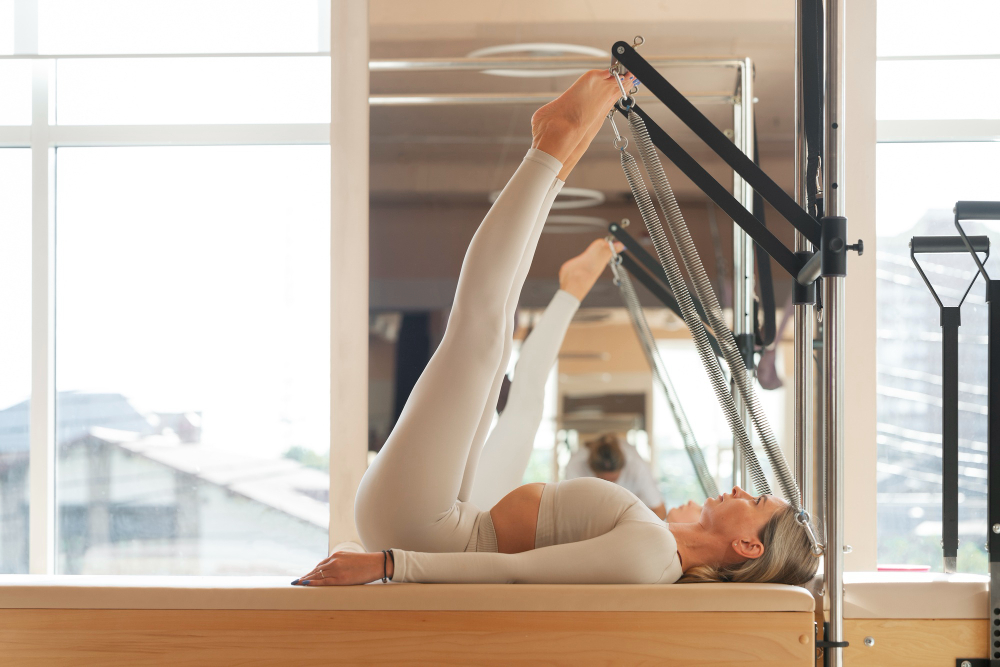
- Footwork: Lying on your back, pressing the footbar with your feet. This teaches you core engagement, breath coordination, and how the Reformer resistance works.
- Leg Circles: Small, controlled circles with one leg while the other is stable. Builds hip stability and core strength.
- Hundred Prep: A breathing exercise that engages your deep abdominals. The classic Pilates exercise that everything else builds from.
- Short Box Series: Sitting on the Reformer, working spine flexibility and core strength.
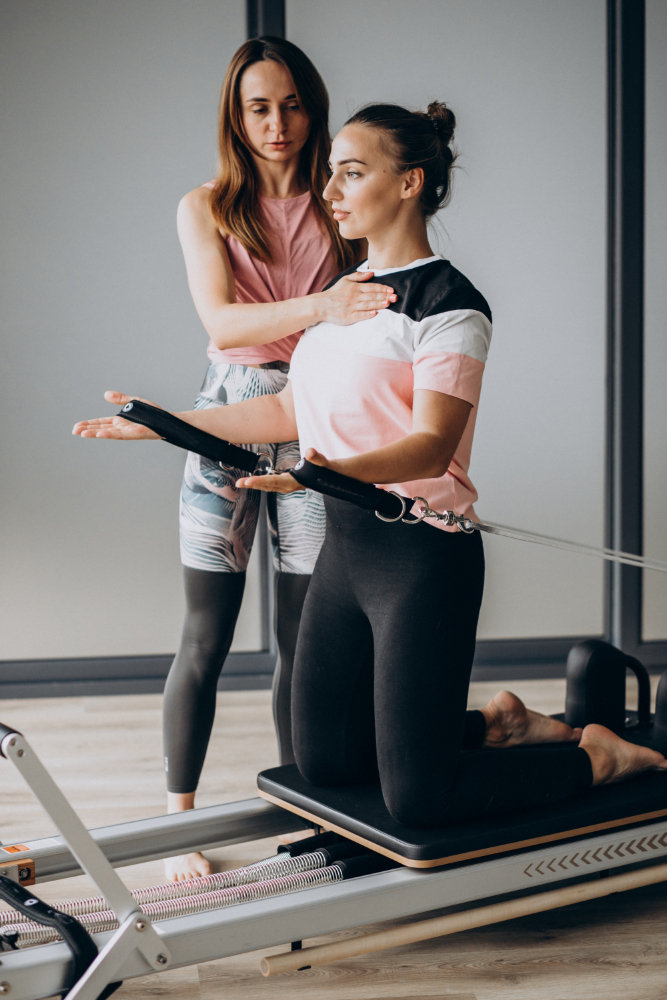
- Knee Stretches: On hands and knees, strengthening shoulders and core while moving the carriage.
What the workout feels like:
- Challenging but doable: I’ll adjust resistance and modify exercises so you’re working hard but not overwhelmed.
- Lots of coaching: I’ll give you constant feedback on alignment, breathing, and muscle engagement.
- Focused on form: We’ll move slowly and deliberately. This isn’t about how many reps you can do.
- Surprisingly difficult: Don’t be fooled by the controlled pace. Pilates works muscles you didn’t know you had.
- Mind-body intensive: You’ll need to concentrate. This isn’t zone-out-and-go-through-the-motions exercise.
What you’ll notice during your first workout:
- Some muscles shaking (totally normal—it means they’re working!)
- Your core muscles burning (that’s where most Pilates exercises originate)
- Possibly feeling muscles you’ve never felt before
- Needing to really focus to coordinate breath with movement
- Feeling both challenged and supported
Part 5: Cool Down and Discussion (5-10 minutes)
We’ll finish with some stretches and a brief discussion about how you’re feeling, what you noticed, and what your next steps should be.
I’ll provide recommendations for:
- How often you should practice Pilates for your goals
- Which format might work best (private, semi-private, mat, equipment)
- Any homework exercises you can practice at home
- What to expect in your next session
After Your First Session: What to Expect
Immediately After You’ll probably feel energized, lengthened, and more aware of your body. Many people describe feeling taller and more aligned after their first Pilates session.
The Next Day (or Two) You will likely be sore—potentially in muscles you didn’t know existed. This is completely normal! Pilates works deep stabilizing muscles that don’t get challenged in most other forms of exercise.
The soreness you’ll feel is different from the burn of lifting heavy weights. It’s more of a deep, widespread soreness that tells you your body worked in new ways. Some common areas of soreness after a first session:
- Deep abdominals (not just surface six-pack muscles)
- Inner thighs
- Shoulders and upper back
- Hip flexors
- Muscles along your spine
This soreness is temporary and will decrease as your body adapts. By your third or fourth session, you’ll likely have much less post-workout soreness.
Common Beginner Concerns (Debunked)
Let’s address the worries I hear most often from new clients:
“I’m not flexible enough for Pilates.” Pilates doesn’t require flexibility—it builds it. I can modify every exercise to work with your current range of motion. In fact, many people start Pilates specifically because they’re inflexible and want to improve.
“I’m not strong enough.” That’s exactly why you should start! Pilates equipment is brilliant because it can assist you when you’re building strength and challenge you as you get stronger. I adjust resistance to match your current ability.
“I have back/knee/shoulder pain.” Pilates is often recommended by doctors and physical therapists for pain management and rehabilitation. With proper modifications, Pilates can help address pain rather than aggravate it. Just make sure to tell me about your concerns before we start.
“I’m too old to start something new.” I’ve taught Pilates to clients in their 70s and 80s. Pilates is low-impact and infinitely adaptable. Age is never a barrier to starting.
“I’m overweight and worried about being on equipment.” All Pilates equipment has weight limits far above what anyone would reasonably need to worry about. The equipment is sturdy and safe for bodies of all sizes.
“I’ll be the only beginner and everyone will be watching me.” At USA Pilates, most sessions are private or small group (2-3 people). You won’t be in a room full of advanced practitioners judging your tree pose. And even if you were, everyone in that room was once a beginner too.
How Pilates Progresses: What Comes Next
After your first session (or first two sessions with our Beginner Package), you’ll have options for how to continue:
Private Sessions One-on-one training continues, with progressively more challenging exercises as you build strength and skill. Private sessions allow for fastest progression and maximum customization.
Semi-Private Sessions Train with a friend or partner once you’ve both learned the basics. This provides motivation and shared experience while maintaining personalized instruction.
Regular Practice Schedule Most clients benefit from 2-3 sessions per week initially, then maintain with 1-2 sessions per week. Consistency matters more than frequency.
Progression Timeline
- Weeks 1-4: Learning fundamentals, building basic strength, improving body awareness
- Weeks 5-8: Adding more complex exercises, increasing difficulty, seeing measurable improvements
- Weeks 9-12: Feeling significantly stronger, moving more confidently, noticing benefits in daily life
- Beyond 3 months: Continuous progression, advanced exercises, maintenance of gains
How to Get the Most from Pilates
Be Patient Pilates requires learning. You won’t master exercises on day one. Trust the process and focus on small improvements session to session.
Focus on Form Over Repetitions Five perfect repetitions beat twenty sloppy ones. Quality matters infinitely more than quantity in Pilates.
Breathe Proper breathing is fundamental to Pilates. When in doubt, keep breathing! I’ll teach you specific breathing patterns, but never hold your breath.
Communicate Tell me if something hurts (beyond normal muscle burn), if you don’t understand an instruction, or if you need a break. Good communication makes sessions more effective and safer.
Practice Between Sessions Even 10-15 minutes of home practice accelerates your progress. I’ll give you simple exercises to do on your own.
Be Consistent Regular practice yields the best results. One session per week is good; two to three sessions per week is better.
Ready to Try Your First Session?
The hardest part of starting Pilates is walking through the door for that first session. Everything after that gets easier as your body gets stronger, more flexible, and more aware.
At USA Pilates in Monument, Colorado, I specialize in making beginners feel comfortable and confident. As one of only 250 Legacy Certified Instructors worldwide, I have the expertise to teach you proper form from day one. And as someone who discovered Pilates as an athlete and has practiced for 18 years, I remember exactly what it felt like to be a beginner.
Our Beginner Pilates Package is designed specifically for you: Two private sessions for $120 where you’ll learn the fundamentals of Pilates in a comfortable, pressure-free environment. By the end of these two sessions, you’ll understand the equipment, know the basic exercises, and have a clear path forward for your Pilates practice.
Contact USA Pilates today: Phone: (719) 696-4258 Location: 16243 Windy Creek Drive, Monument, CO 80132
Don’t let uncertainty keep you from trying something that could transform how you feel in your body. That first session is just the beginning of a journey toward strength, flexibility, and a deeper connection with yourself.
Every expert was once a beginner. Every strong Pilates practitioner started with their first shaky plank. You’re exactly where you need to be.
About the Author: Jenna Dorsey-Spitz is the owner and lead instructor at USA Pilates in Monument, Colorado. With 18 years of Pilates experience and certification as one of only 250 Legacy Certified Instructors worldwide, Jenna specializes in making Pilates accessible and effective for beginners. She discovered Pilates during her collegiate running career and has since helped hundreds of clients—from complete beginners to elite athletes—discover the transformative power of this practice.